
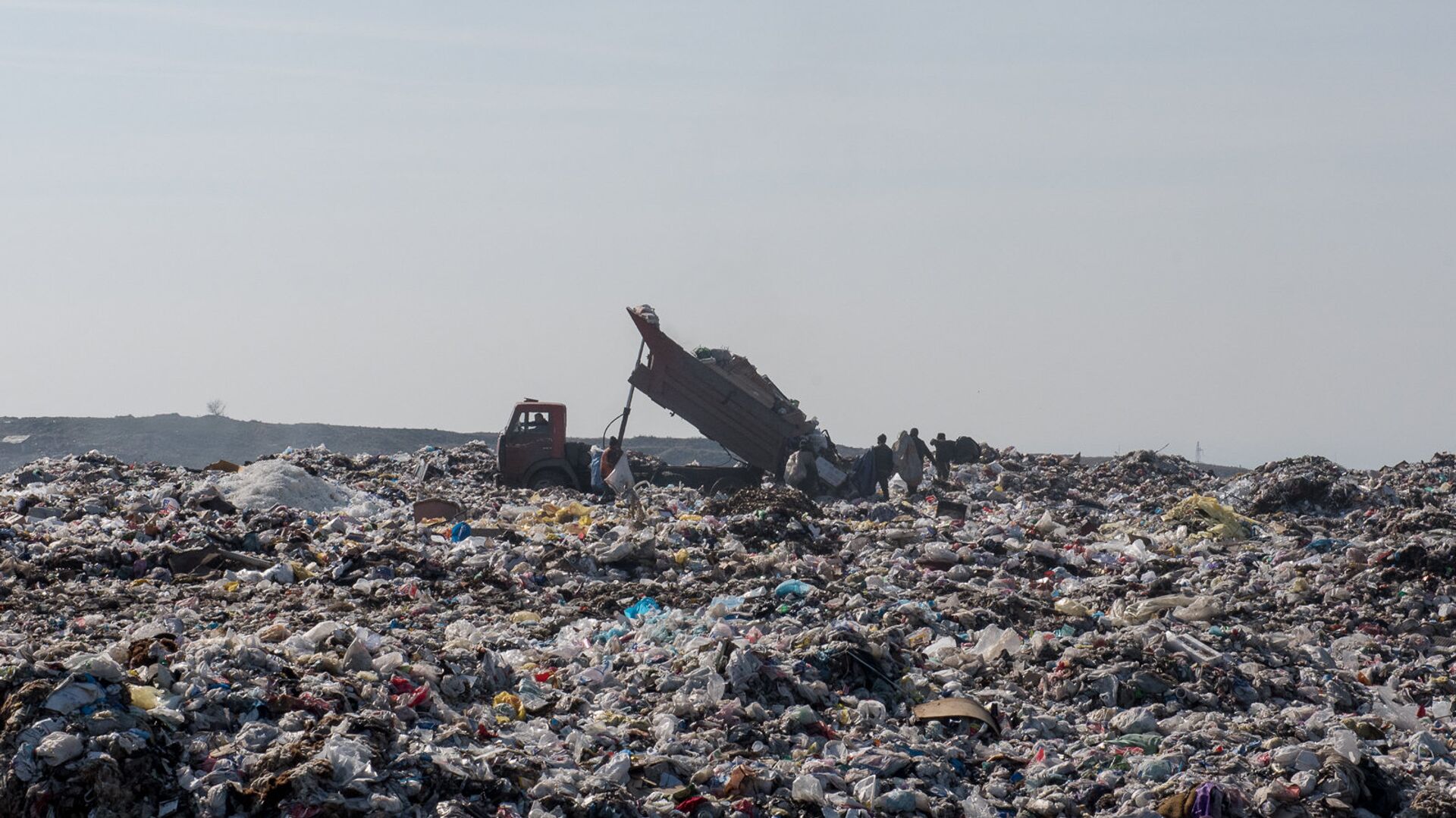
Starting from 2027, the sale of plastic bags of any thickness, single-use tableware, and cutlery made of plastic and polystyrene foam is prohibited in Armenia. The Law on Amendments to the Law "On Trade and Services" (adopted by the National Assembly in March 2026)—at first glance, this is an unambiguous environmental victory.
But back in February, during the first reading, Deputy Minister of Environment Ara Mkrtchyan directly stated in parliament: "On the eve of COP-17, Armenia must present itself as a responsible country committed to the principles of sustainable development."
This isn't a phrase taken out of context—it is the central argument for presenting the law to parliament. There is no detailed environmental justification in the hearing materials: no data on the amount of plastic in rivers and landfills, no analysis of alternatives, and no assessment of the impact on recycling. The official formulation from the Ministry of Environment sounds like this: "As an alternative, the Ministry recommends reusable bags made of paper or textile." This is the only "alternative policy" in the bill—a recommendation to switch to paper, without any analysis of what will happen to it next.
And this looks like the real justification for passing the law—it is needed not for environmental improvement, but for officials to show off. Unfortunately, the real picture is much more complex.
What exactly is being banned?
Since January 1, 2022, plastic bags thinner than 50 microns have already been prohibited in Armenia. This has had absolutely no effect on the prevalence of single-use bags, but the bags have become thicker and more expensive.
The next stage, which will come into force on January 1, 2027, extends the ban to:
- all polyethylene bags without exception;
- single-use plates, cups, and lids for them;
- spoons, forks, knives, straws, and stirring sticks.
Exceptions are made for bags used for weighing and packaging goods, garbage bags made from recycled materials, and plastic containers with lids for packaging. Control is assigned to the Market Supervision Inspection Body and local self-government bodies. Sanctions include a warning for the first violation and a fine of 100,000 to 150,000 drams for repeated violations.
Sounds reasonable. But let's see what happens in practice. What are we being offered to replace single-use items with?
Paper cups are also plastic, just non-recyclable
After 2022, the market was flooded with "alternative" single-use tableware: paper cups, laminated containers, "biodegradable" utensils. There are several manufacturers of such tableware in Armenia, even with the word "Eco" in their name.
Virtually all single-use paper cups, dishes, and food containers are coated on the inside with a thin layer of polyethylene—without it, the paper would get soaked in a minute. The coating is thin and tightly bonded to the base, making it practically impossible to separate; therefore, waste paper recycling companies do not accept such cups.
To prevent the paper from leaking, manufacturers coat the inner—and sometimes outer—walls of the cup with a special polypropylene film or apply an LDPE coating. Because of this, such containers cannot be recycled—to reuse the cardboard, it must be separated from this liner. Doing this is not easy, as the coating is thin and also tightly bonded to the paper base.
In Russia, only one large enterprise has mastered the recycling of laminated paper tableware, converting it into pulp-board—egg trays and takeaway coffee cup holders. However, such recycling was economically inefficient until extended producer responsibility was introduced. Now, packaging manufacturers (including cups) are required to either recycle 55% of their volume (in 2025) or pay a huge environmental fee (about 57,200 rubles per ton).
Work is underway to replace lamination with biopolymers that will allow such dishes to be recycled along with regular paper; such packaging has begun to appear in Russia, but it is not available in Armenia. Technologies are also being developed to process agricultural waste into single-use containers, but the problem with them is the same as with PLA—they must be composted.
"Biodegradable" doesn't mean "decomposes in a landfill"
The second popular answer to the ban is tableware and bags made of PLA, a polylactide based on corn starch. The packaging says "biodegradable," and this is technically true. But with a significant caveat.
PLA decomposes at temperatures above +58°C under industrial composting conditions. In a landfill, in a trash bin, or in nature, such a coating behaves exactly like ordinary plastic—it breaks down into microparticles under the action of sunlight but does not disappear. There is no industrial composting in the country yet.
In December 2025, the Yerevan Municipality launched a tender for the construction of a waste processing complex in Nubarashen, the technical specifications of which provide for biological stabilization of organics—essentially composting. But the investor has not yet been selected, and construction dates have not been determined, which means that promoting PLA tableware and bags as a "biodegradable alternative" is, at the very least, incorrect.
Oxo-degradable bio-bags are more dangerous than regular polyethylene
The third "eco-friendly" option flooding the market instead of banned bags is bags with oxo-additives. They are labeled as d2w, EPI, TDPA, or simply "biodegradable." In reality, this is ordinary polyethylene with additives that accelerate plastic fragmentation under the influence of oxygen, heat, and UV light.
The fundamental difference from a regular bag: it breaks down into small fragments faster. But it is precisely microplastic—it doesn't disappear; it goes into the soil and water. The European Union banned the production and sale of such products from 2021 under Directive 2019/904 on single-use plastics—precisely because the SAPEA committee (the EU's scientific advisory body) concluded that oxo-degradable plastics are not truly biodegradable but generate microplastics faster than regular polyethylene.
In Armenia, the labeling of such bags is not regulated at all. They are sold as an "eco-alternative"—and will continue to be sold that way after 2027 because the new law bans "polyethylene" bags, while the status of oxo-degradables remains uncertain.
Polyethylene is recycled in Armenia
An important point lost in the public discussion: polyethylene is one of the most well-recycled plastics. Bags made of LDPE (low-density soft polyethylene) and HDPE (high-density hard polyethylene, used for bottles and some bags) have a stable secondary raw material market even in Armenia. Separate collection of such plastic is organized in Yerevan and some other cities, but public education efforts are very inactive.
Now let's compare: paper cups with polyethylene lamination are not recycled because it's practically impossible to separate the paper and the film. PLA tableware requires industrial composting, which does not exist in Armenia; it contaminates the regular recycling stream. Oxo-degradable bags are the same as regular polyethylene, only with accelerated breakdown into microparticles.
The result is a paradoxical situation: the law bans a material that, in principle, could be recycled and paves the way for alternatives that are not recycled at all.
Polypropylene cups—the alternative that went unnoticed
While the discussion revolves around "paper vs. plastic," a specific and solvable task is being missed: replacing single-use tableware made of polystyrene (PS, marked "6") with polypropylene (PP, marked "5").
The main problem with polystyrene is that it is not recycled. It is easily contaminated with food, poorly sorted, and economically unprofitable to recycle. Upon contact with hot food, polystyrene can release harmful substances, including styrene, and in nature, it decomposes extremely slowly and easily turns into microplastics.
In Armenian conditions, real alternatives to polystyrene remain reusable tableware (provided it is actually used many times, not just "for show") and single-use tableware made of PP (polypropylene, marked 5). PP is honestly recycled, is not a composite, and does not create an illusion of "eco-friendliness" as happens with polystyrene and pseudo-eco materials.
There is a fundamental nuance here: the new law bans all single-use plastic cups—including PP. That is, a potentially reasonable replacement (PS → PP with separate collection) is legislatively equated to knowingly problematic options. At the same time, a paper cup with lamination—which is worse in all recycling parameters—is not banned by the law because it is "paper."
A smart alternative would look different: a ban specifically on polystyrene as a non-recyclable material, with a transition to PP in conjunction with the development of a separate collection system. This would be an environmentally justified decision—unlike a total ban on all single-use plastic tableware, which opens the way for laminated paper.
Are paper bags definitely better than plastic?
Intuition suggests: paper is natural, plastic is not. But if you look at the full life cycle of production, everything turns out to be more complicated.
In 2018, the Danish Environmental Protection Agency published one of the most comprehensive studies—a life cycle assessment of different types of bags across 15 environmental categories: climate impact, water consumption, resource depletion, eutrophication, and others. The conclusion: with proper disposal (reuse and recycling), an ordinary polyethylene bag turns out to be one of the best options according to most indicators.
A paper bag must be used at least 43 times for its total climate impact to equal that of a single-use plastic bag. In terms of water consumption and resource depletion, paper loses to plastic even more significantly.
There are several reasons: paper production requires 2–4 times more energy than the production of the same volume of polyethylene. A paper bag weighs 5–10 times more than a plastic one—its transportation carries a larger carbon footprint "by default." The pulp and paper industry is one of the largest consumers of fresh water.
Kraft paper for the production of "eco-friendly" bags in Armenia is entirely imported. This is directly confirmed by a report on a local paper bag manufacturer: "We received two billion drams from the state to buy raw materials"—the state subsidized the purchase of imported raw materials. At the same time, interestingly, this report mentions subsidizing the production of laminated paper tableware, which is not eco-friendly.
And most importantly. Paper bags will also go to the landfill, where they do not decompose! There are 60 landfills in Armenia, and not a single one of them performs sorting, recycling, or reuse of waste. At the Nubarashen landfill, both paper and plastic lie equally under a layer of soil without oxygen access. Under anaerobic conditions, paper decomposes very slowly and releases methane.
Shoppers—are they more eco-friendly than bags?
"Buy a reusable bag" is the most obvious advice. This is a good idea, but its environmental price depends on the material and the number of actual uses.
- A polypropylene shopper (like an IKEA bag) must be used at least 52 times for its production to pay off in terms of climate footprint relative to a plastic bag.
- A cotton bag—requires 131 uses in terms of climate impact—due to the enormous water consumption during cotton cultivation.
One kilogram of cotton requires about 10,000–15,000 liters of water under traditional irrigated agriculture (data from Mekonnen & Hoekstra, Water Footprint Network).
None of this means that a shopper is a bad idea. It means that it should be a long-term replacement, not just another souvenir bought at a promotion and thrown away in a month.
Comparison of Alternatives
| Material | Pros | Cons | Condition under which it works |
|---|---|---|---|
| Polyethylene bag | Recyclable; minimal carbon footprint during production; low water consumption | Does not decompose in a landfill | Separate collection and actual recycling |
| Paper bag / laminated tableware | Perceived as "natural" | Polyethylene layer makes recycling extremely difficult; 2–4 times more energy-intensive than plastic; | Without lamination—only with 43+ repeated uses; with lamination—doesn't work anywhere |
| Single-use cup from polypropylene (PP) | Recycled in Armenia within existing infrastructure; single material without lamination | Still single-use; requires separate collection | Separate collection—already works; preferable to polystyrene and laminated paper |
| PLA tableware | Made from plant-based raw materials; decomposes—but only under the right conditions | Requires industrial composting from +58°C; in a landfill behaves like regular plastic; contaminates recycling stream | Only if industrial composting is available (not yet in Armenia) |
| Oxo-degradable bags (d2w, EPI) | Fragments faster than regular polyethylene | Generates microplastics faster than a regular bag; banned in the EU since 2021; unregulated in Armenia | Doesn't work anywhere—produces microplastic by definition |
| Polypropylene shopper | Durable; multiple use is realistic | Needs at least 52 uses to offset carbon footprint; often discarded earlier | Only with actual long-term use |
| Cotton shopper | Entirely natural material; contains no plastic | 131 uses by climate footprint; enormous water consumption during production | Only when used for years and in regions without water scarcity |
| Reusable tableware (metal, glass) | The only option without compromises with regular use | High carbon footprint of production; weight during transportation | Always works—provided actual multiple use |
What to do?
A ban is the simplest political answer to the visible problem of pollution. But without infrastructure, a ban does not solve the problem; it only moves it elsewhere.
What actually works:
Separate collection and recycling. Instead of banning recyclable materials, it makes sense to invest in their recycling infrastructure: containers for recyclables, transportation, plants. This is more expensive and politically less flashy, but much more effective. In Yerevan, Hrazdan, Sevan, and Gyumri, a system for the separate collection of various fractions is already functioning, but the state clearly does not invest enough in popularization.
Improvement of landfills and construction of waste processing plants—so that as little waste as possible gets to landfills, and what does get there does not decompose and release methane.
Industrial composting. If PLA and biodegradable packaging are promoted, infrastructure for their proper disposal is necessary. Without composting facilities, bioplastic is marketing, not a solution.
Extended Producer Responsibility. A legislative mechanism that shifts the financial and organizational burden of waste disposal from the state to companies that produce or import goods and packaging. According to this system, businesses are obliged to either independently ensure the collection and recycling of a set percentage of their products or pay an environmental fee to the budget to fund waste management infrastructure.
Labeling regulation. A ban on the words "biodegradable," "eco," "100% natural" without compliance with verifiable standards—EN 13432, ASTM D6400, and analogues. Consumers are currently making decisions based on misleading information.
Economic incentives for reuse. Not a ban, but discounts for brought containers, deposit systems for reusable tableware during delivery, development of refill culture—things that change behavior without replacing one single-use material with another.
Bottom line?
A ban does not solve the pollution problem—it only changes the composition of waste in the landfill and increases costs: for consumers on more expensive packaging, for the state on subsidies to paper tableware manufacturers, and for businesses on restructuring logistics. The real environmental result is close to zero, but there is a beautiful slide for a presentation at COP-17.