
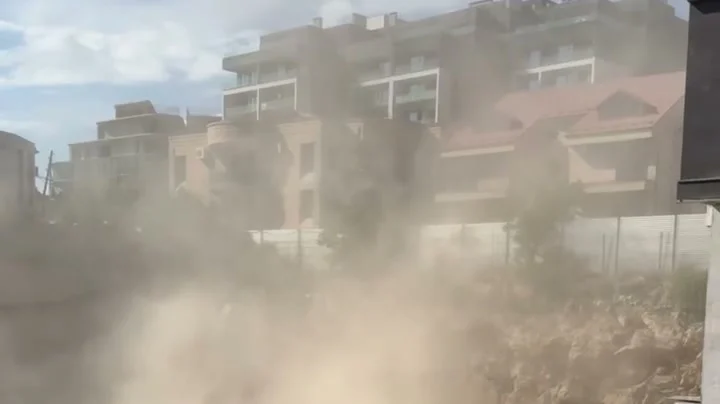
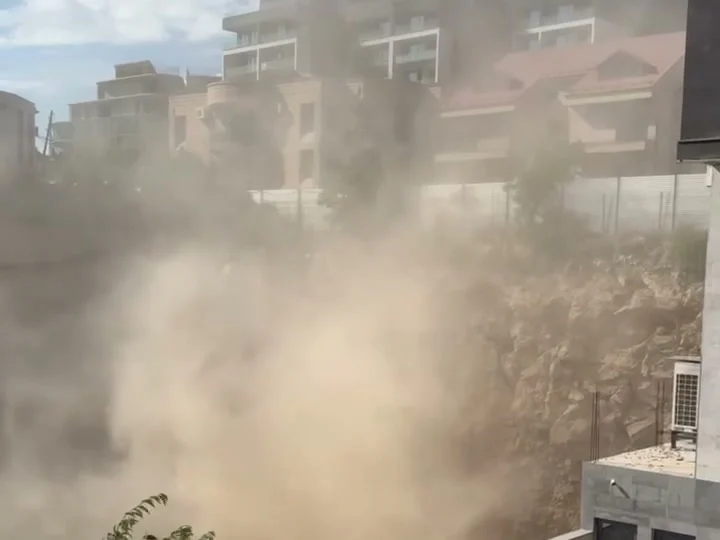
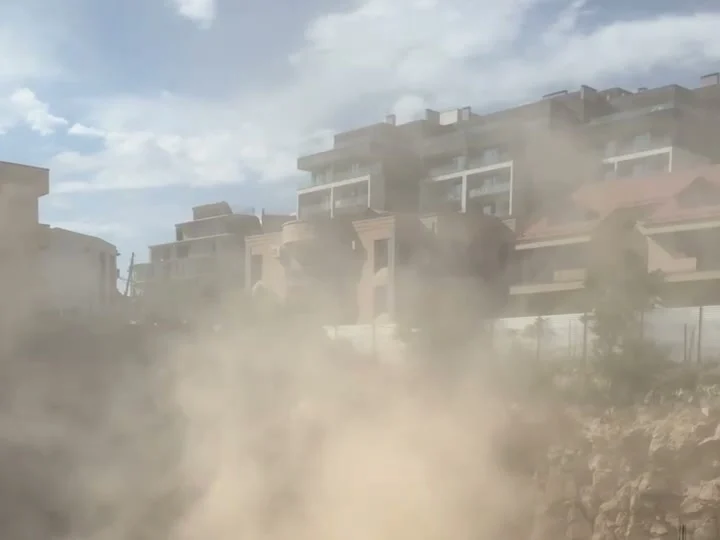
In July 2026, in the very center of Yerevan, next to apartment buildings, an excavator was working in a pit — and a dense cloud of dust rose out of it. You can see it with the naked eye: it covers facades, settles on balconies, and goes into windows. This is the picture city authorities usually call “construction pollution,” and this is what the municipal sensors on the sites are supposed to catch.
The problem is that these sensors were not built for this dust.
What was installed on the sites
Since 2022, the municipality has required air monitoring at major construction sites. The first Clarity Node-S units appeared in an ADB pilot, then the network grew quickly. It is now the backbone of municipal data on gis.yerevan.am: more than a hundred locations, often two sensors per site. We pull this data into AirQuality.am and treat it as the best in the city — for PM2.5.
Clarity itself, in its Yerevan case study, describes the network as construction monitoring. Read closely, though, and the goal and the thresholds are always the same: PM2.5. Not dust from crushed stone and soil — fine particles.
The Node-S is a box with a solar panel and a cellular link. Inside is an optical particle counter, the Plantower PMS-6003, and an NO₂ sensor. It is the same class of instrument as Purple Air and AirGradient. For urban smoke, traffic exhaust, and winter smog they work well: after calibration they give a picture close to a reference monitor, as we already wrote.
Construction dust is a different story.
What construction dust is, and what Plantower can do
What you see in the frames is mostly coarse particles: soil, rock, concrete. That is PM10 and larger. There is a fine PM2.5 fraction on sites too, especially from diesel equipment, but the visible cloud is held up by the coarse grains.
The CSTEP 2025 guidance is about exactly this: on construction sites the PM2.5/PM10 ratio is usually 0.06–0.4. Most of the mass is coarse particles. Sensors like Plantower see particles smaller than a micron well and strongly under-read the 2–10 µm range.
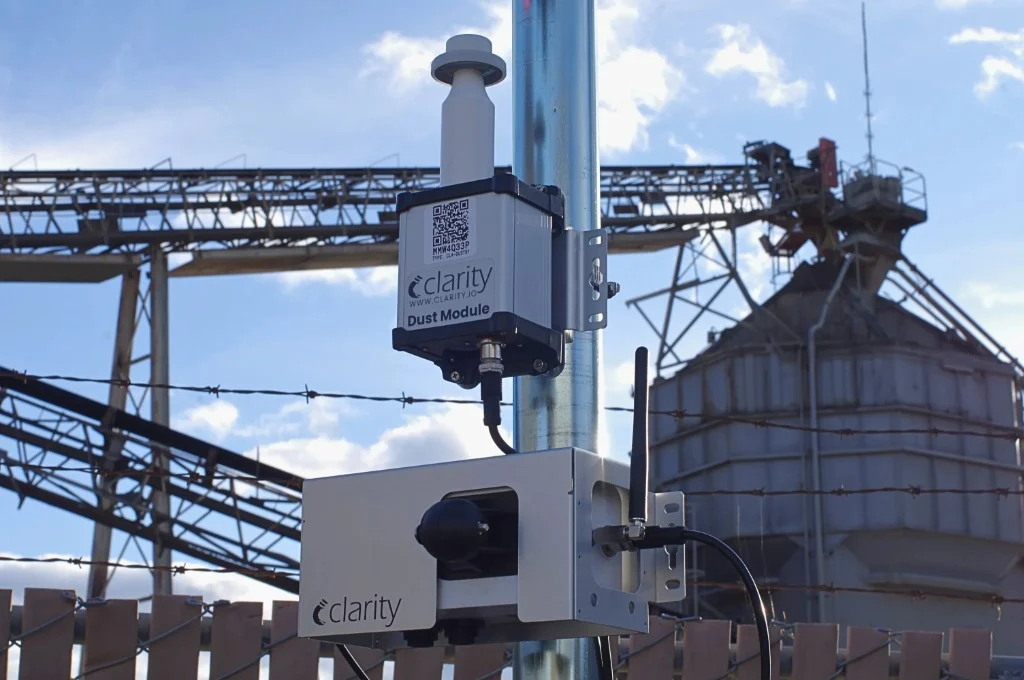
The Node-S GIS feed also has PM10. That is not a separate dust instrument. Clarity itself says Plantower-based sensors have no direct PM10 measurement; the value is calculated from PM2.5. For real coarse dust the company sells a different product — the Dust Module: a separate unit with a heated inlet, a range up to 10,000 µg/m³, plus TSP.
The city does not have Dust Modules
Clarity officially launched the Dust Module on 25 March 2026. Yerevan’s network was installed earlier: a 2022 pilot, a contract with the city’s technology center on 29 November 2023, and about 150 Node-S units by the end of 2024. The Yerevan case study never mentions the module. The city’s plans there are to add NO₂ and later look at quarry dust.
The module is a separate add-on on the Node-S; you would not confuse it with the base sensor. Photos of Yerevan stations do not show these add-on modules.
Why this matters
The municipality puts sensors on sites and says it is controlling construction dust. In winter, the same network is used to explain the smog with construction and weather. Our winter report already showed that the daily pattern does not fit that story: a morning low, a peak around 20:00–21:00, when the sites are winding down and the city is heating and driving.
The summer frame from a pit in the center adds the other half: even when the dust is real and visible, the instrument on the site is not looking at it. That is a closed loop. A network that cannot see coarse dust cannot prove that construction is the main winter source of PM2.5, and it cannot answer residents who have dust at their windows.
That does not make the municipal stations useless. For winter PM2.5 — heating, traffic, secondary aerosol — the Node-S is the right tool, and we rely on that data. A sensor on a construction site just does not measure construction dust.
If the city wants to regulate dusting, it needs instruments that measure PM10 directly: Dust Modules, a different class of optical counters, or reference stations. Until then, arguing with residents using GIS charts is pointless. They can see the cloud in the photo better than a Plantower can.