
This time we have a big update post: lots of work done, lots to show.
Updated Telegram Digest Design and Schedule
The most noticeable change, which has already sparked some debate. The main information is now displayed on an image, and a sensor map has been added—you can see in detail what's happening in Yerevan and slightly less detail in other cities.

For Yerevan, you can see the trend over the last 8 hours and the last 7 days to understand whether the air quality is improving or deteriorating. Since we freed up some text space, we added information about how the air compares to WHO requirements and the cigarette equivalent.
Perhaps some people don't need this information, but it's a visual comparison that can help spread awareness that air shouldn't be like this.
The digest still updates approximately every 15 minutes, but now it's published in the feed once per day instead of four times—to avoid spamming.
New Articles on the Site
Instead of links to lengthy WHO standards PDFs and cigarette equivalent methodology descriptions, we created short overview articles covering the key points from these documents.
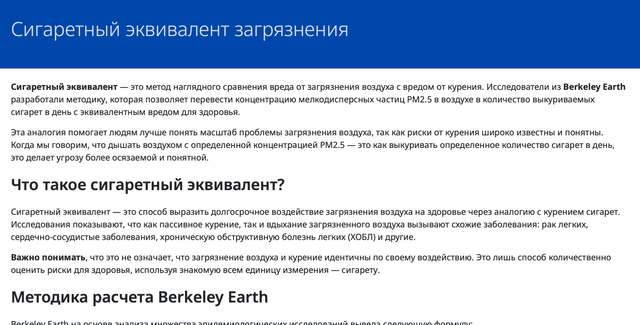
They explain why these particular standards were adopted and how they relate to standards in Armenia. These pages have a comments section—it works; questions and feedback are welcome.
Additionally: local standards have been analyzed and added to the air pollutants section, and the AQI calculation table has been moved to a separate page because NO₂ levels are now included in the calculation.
Data Export Updates
The open data principle remains: collected and processed data is available in the open data section. New exports and measured parameters have been added.
Uniform Colors on Maps and Charts
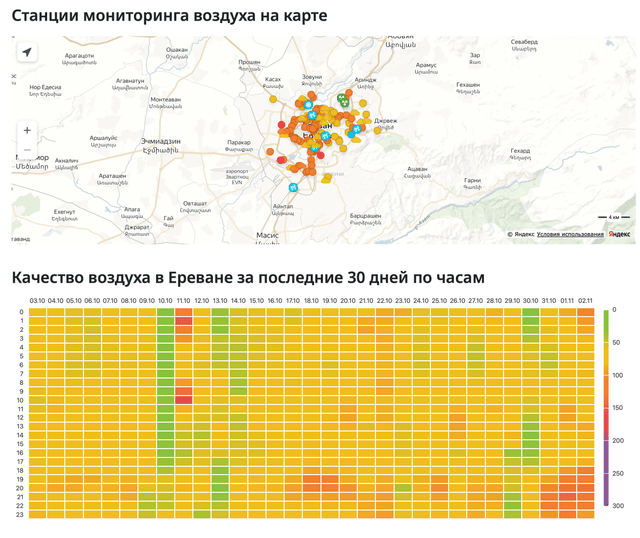
It seems like a small thing, but all indicators on maps and charts have been unified into one scheme. Pollution levels still correspond to colors. An offline sensor is gray. A sensor that doesn't provide air quality data but provides other data is blue.
Weather monitoring sensors don't provide real-time data, so they're displayed in blue.
Updated Information Sources Section
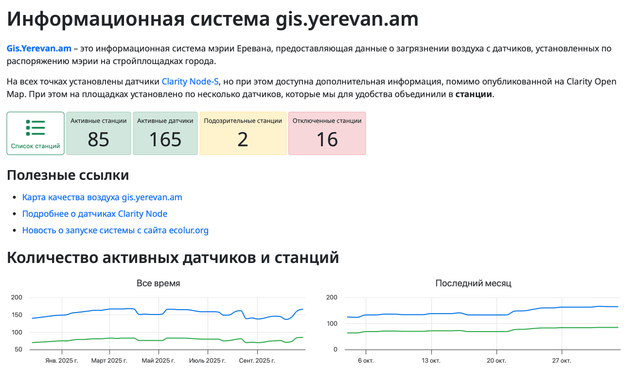
Active station charts have become more informative, with a summary of working and non-working sensors. For Yerevan municipality sensors, you can see how many sensors are active and how many stations (construction sites whose data is combined) are active. You can view all sensors from one source as a list.
For Tumo Labs and some others, the charts show how many stations provide air quality data and how many provide only weather data.
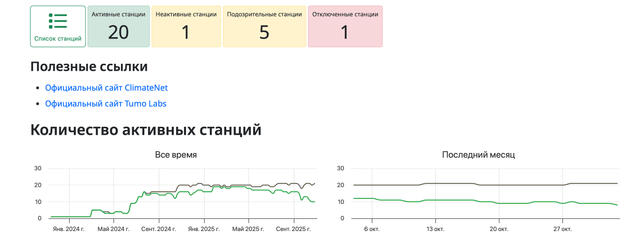
The chart shows how the sensor network is degrading. They're still working, but there are fewer and fewer "live" ones with air quality data.
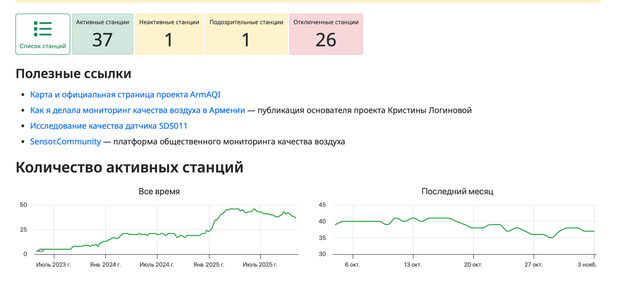
The ArmAQI network, unfortunately, has stopped developing, and sensors are gradually failing.
Media Coverage of Air Quality in Armenia
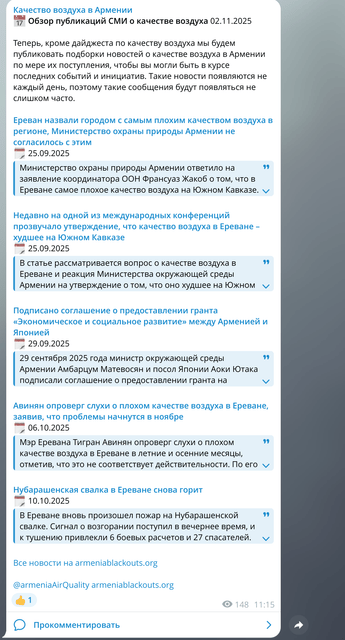
It's important to track how the media covers the air problem and how authorities respond. The digest shows that the Yerevan municipality acknowledges the problem and somehow tries to address it (success is another question), while the Ministry of Environment refuses to acknowledge problems and issues vague comments like "you're all lying." We'll see how the picture changes in the future.
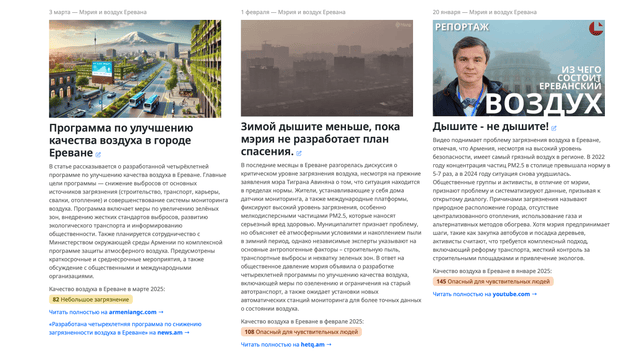
The average air quality for the month of publication is added to articles. When switching languages, articles are automatically translated (OpenAI models)—there may be inaccuracies in wording.
So the article collection doesn't get lost, a news digest is published on Telegram: once a day at 11:00, only if there's something to show.
Information About Partners
The project is run mostly solo, but there's help with information and event organization; without support, it runs on enthusiasm alone. The "About" page now includes the author's signature and a list of partners.
This post turned out long—thank you for reading, and thank you for your interest in the project.